
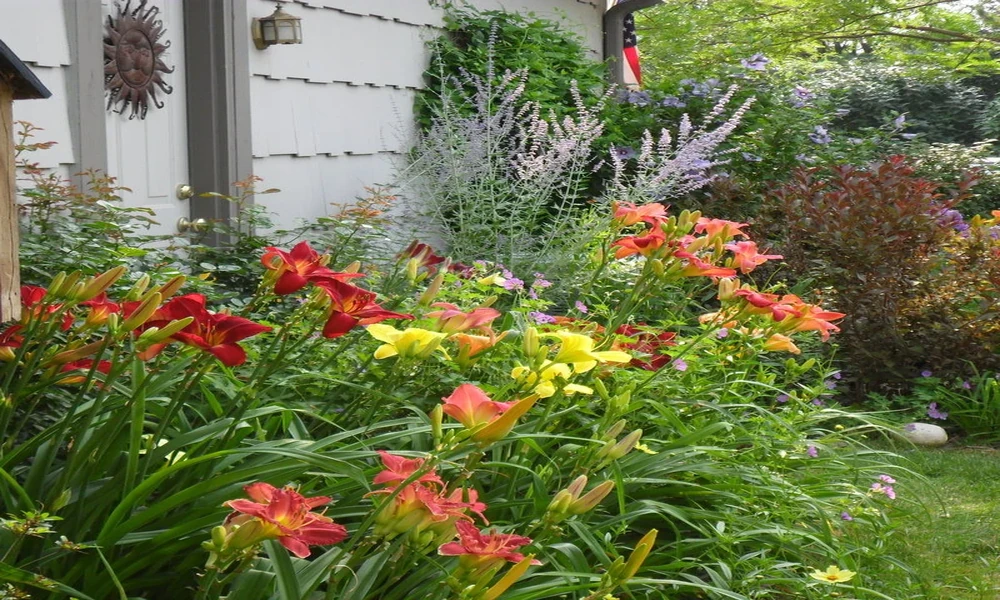
A flower photograph leaves quite a lot outside the frame. It rarely shows how far a daylily’s leaves reach, whether the flower stems sit just above them or rise well clear, or how a colour changes beside neighbouring plants. A nursery garden can supply that missing perspective. Among established clumps, it becomes easier to imagine the plant taking its place at home.
These five British nurseries combine daylilies for sale with opportunities to visit. The opportunities are seasonal and different in character: published open days, a specialist collection seen by appointment, or a perennial garden beside a nursery. This is a guide to planning a worthwhile visit during the appropriate season, not a promise that all five gardens are open today. Some have already finished their current visitor programme, making the next flowering season the sensible time to aim for.
Choosing a nursery worth the journey
The selection brings together a commercial Hemerocallis range, documented visitor access and a garden or display that can help a buyer judge plants in context. The order begins with specialist daylily settings and finishes with a broader perennial garden. Within that route, the emphasis is on what a visit contributes to choosing, rather than garden size, awards or an assumed quality score.
Seasonal information matters as much as location. A nursery selling plants throughout the year may open its display only briefly, and a garden ticket need not give access to every sale plant. Check the current programme and arrange any required appointment before travelling. No personal visits are claimed here; the opportunities described come from the nurseries’ own visitor and ordering information.
1. Swallowtail Daylilies
For a British nursery visit centred on choosing daylilies, SwallowtailDaylilies offers the useful connection between specialist sale stock and display plants seen by prior arrangement. The nursery is in Wimbotsham, Norfolk, and points visitors towards late June and July. A conversation about timing belongs at the beginning of the plan, because the reason to travel is to see the plants at a revealing stage of growth.
The range gives that visit a purpose beyond choosing a favourite colour. Flower forms, compact selections and plants intended for broader landscape use represent different possibilities in a garden. Standing back from an established clump can help settle which possibility you want: a flower near the front of a planting, a taller accent above surrounding foliage, or several plants occupying a larger sweep of border. These are questions of proportion as well as taste.
It is worth taking a simple note of the space waiting at home. Include the approximate width, the light it receives and the height of its neighbours. Those details give a nursery conversation something concrete to work with, without turning a relaxed visit into a technical exercise. A large bloom admired close up may create a different effect when viewed from the end of a path, and the display offers a chance to consider that difference.
Buying and viewing should still be connected deliberately. Pot-grown plants are supplied, and collection can be arranged in advance by telephone, with payment on collection. If one named variety is essential, establish its availability before the journey. A nursery display helps you choose; it does not establish that every plant visible in the ground has an equivalent pot ready to take away. The strength of this visit is the opportunity to bring the garden idea and the specialist offer into the same conversation.
2. Strictly Daylilies
At Strictly Daylilies in Histon, the appeal is immersion in a garden devoted to the subject. Its display gardens and specialist nursery give visitors a reason to compare daylilies against other daylilies, rather than try to make every judgement from separate catalogue photographs. The published open-garden programme is the route into that experience. The next advertised dates fall in July, so this is a visit to put in the diary and verify against the current programme.
A concentrated display can make small differences easier to notice. Look at the relationship between a flower and its stem, the spacing of buds and the amount of foliage beneath the display. A plant that seems restrained in a close photograph may have considerable presence as a clump. Conversely, a heavily patterned flower might be just the punctuation a quieter border needs. The garden supplies the context in which to make those judgements for yourself.
There is a separate commercial detail to keep in mind when turning that impression into an order. Strictly Daylilies grows plants in pots but describes its mainland UK mail-order supply as bare-root divisions. A visitor should discuss the purchasing arrangement appropriate to the occasion instead of assuming that a display plant, a sale plant and the posted format are interchangeable. This nursery earns its place through the depth of the daylily setting; the useful outcome is a better-informed selection, whether the agreed order travels with you or follows through the nursery’s normal system.
3. New Hope Daylilies
New Hope Daylilies makes a summer visit particularly relevant to the gardener who wants to see plants and then compare potted examples. Its open weekends fall in June and July at Colebatch in Shropshire, with July normally the main flowering period. The published programme offers a clear starting point for planning, while acknowledging that different cultivars open at different times.
The sale information adds a practical dimension to the garden. Potted plants can range from two litres to seven and a half litres or larger, and prices reflect size as well as the rarity of the cultivar. Seeing those plants gives the buyer something an online bare-root price cannot convey: the scale of the particular specimen under consideration. A larger pot may suit a border needing a more substantial starting plant, while a smaller example can be a sensible way to spread a budget across several choices.
There is also scope for arranged group visits during the flowering season, with a talk forming part of the programme. For a gardening group, this offers a shared way to learn what to notice before everyone gravitates towards a different favourite. The value lies in the nursery’s documented arrangements, not an assumption that individual tuition is included in every casual visit.
Allow the display and the buying decision to inform one another. If a plant catches your attention in the garden, ask which size is available and how its collection price relates to the listed mail-order division. That small clarification preserves the pleasure of choosing while making the final purchase intelligible. The nursery’s combination of seasonal access and varied potted stock is what distinguishes this visit from simply collecting an order already chosen at a screen.
4. Pollie’s Daylilies
Pollie’s Daylilies is the visit to consider when the familiar daylily flower has begun to seem only part of the story. Its National Collection of spider and unusual-form Hemerocallis gives a particular focus to the display garden near Lymington in Hampshire. Slender, extended or curling flower parts can create a very different impression from a broad, rounded bloom, especially when several stems are seen together.
The nursery describes its flowering display as a living catalogue and admits visitors by appointment during the season. The current visitor season has ended, while collection of plant orders continues by arrangement. Plan the garden experience for the next suitable opening period and confirm that the display will be accessible. A collection appointment outside that period should not be treated as a substitute for a flowering-season tour.
The buying process is refreshingly specific. There is no shopping cart: the catalogue is downloaded and availability is checked by email. That makes a note of the exact cultivar name particularly valuable during a future visit. The display collection is broader than the commercial selection, so a plant admired in the ground may lead to a discussion about availability rather than an immediate purchase.
This is nevertheless a positive reason to plan ahead for a visitor interested in flower form. The specialist collection offers comparisons that would be difficult to recreate by looking at a few isolated pots. A flexible shopper can use the visit to refine a preference for certain shapes and proportions, then choose from the plants the nursery can actually supply. The experience has value even when the original favourite proves to be a display plant rather than current sale stock.
5. Bluebell Cottage Gardens
Bluebell Cottage Gardens in Cheshire changes the scale of the comparison. Here a daylily can be considered as part of a wider perennial garden, with the nursery providing plants to carry an idea home. This is a particularly attractive approach for someone who wants a coherent border rather than a collection devoted entirely to Hemerocallis.
The commercial Happy Returns offer shows why that broader setting is relevant. The nursery describes a compact daylily reaching around forty centimetres and supplies it in different formats, including a one-litre pot restricted to collection. A visitor considering a lower planting can explore the proportions of the garden and then look at the actual sale size. The argument for visiting is the relationship between garden context and the nursery offer, not a claim that this particular cultivar will always be flowering in the display.
Opening is seasonal, with published days and a late-September end to the current programme. Collection outside ordinary opening hours can be arranged separately, which is convenient but does not automatically include garden access. For a visit intended to help with design, choose a time when the garden itself is open and leave room to walk through it before settling the purchase. The daylily may ultimately be only one component of the plan; seeing how foliage and flowers share space can be the most useful thing brought home.
Bring home a choice you can place
A short record is more useful than a long list of admired names. Note the cultivar, where you imagined it growing and what made it seem right for that position. Add the offered size and any agreed ordering arrangement. With permission, a photograph that includes the surrounding clump can preserve the very context that first made the visit worthwhile.
Then return to the space at home. If the plant needs room that is not available, keep the idea for another project. A successful nursery visit does not require taking away every favourite; it leaves you better able to recognise the offer that belongs in your garden.
Source note: Official websites, visitor programmes, garden descriptions, catalogues and ordering pages published by Swallowtail Daylilies, Strictly Daylilies, New Hope Daylilies, Pollie’s Daylilies and Bluebell Cottage Gardens informed this seasonal visiting guide.