
A Homeowner’s Guide to Smarter, Greener Living
As energy costs continue to rise and environmental awareness grows, homeowners are increasingly looking for smarter ways to heat and ventilate their homes. One technology quietly revolutionising domestic air quality and energy efficiency is the Heat Recovery Ventilation (HRV) fan – a sophisticated yet elegantly simple device that lets you breathe fresh air without throwing your heating bill out of the window.
This guide explains how HRV fans work, why they matter, and how the latest smart-enabled models are taking home comfort to a whole new level.
What Is a Heat Recovery Ventilation Fan?
A heat recovery ventilation fan – sometimes called an HRV unit or a mechanical ventilation with heat recovery (MVHR) unit – is a type of ventilation system designed to exchange stale indoor air with fresh outdoor air, while simultaneously reclaiming up to 95% of the heat that would otherwise be lost.
Traditional extractor fans simply push warm, moisture-laden air out of the home and allow cold external air to rush back in to replace it – a process that wastes considerable energy, particularly in winter. An HRV fan takes a fundamentally different approach.
How Does a Heat Recovery Fan Work?
At the heart of an HRV fan is a heat exchanger – typically a small ceramic or aluminium core that alternates between two modes:
- Exhaust phase: The fan draws warm, stale air out of the room and passes it through the heat exchanger core. As the air passes through, it heats up the core material.
- Supply phase: The fan reverses direction and draws fresh air in from outside. This incoming air passes through the same now-warm core, picking up the stored heat before entering the room.
This alternating cycle – typically switching every 60 to 70 seconds – ensures a continuous, balanced exchange of air. The result is a constant supply of fresh, pre-warmed air that dramatically reduces the thermal penalty usually associated with ventilation.
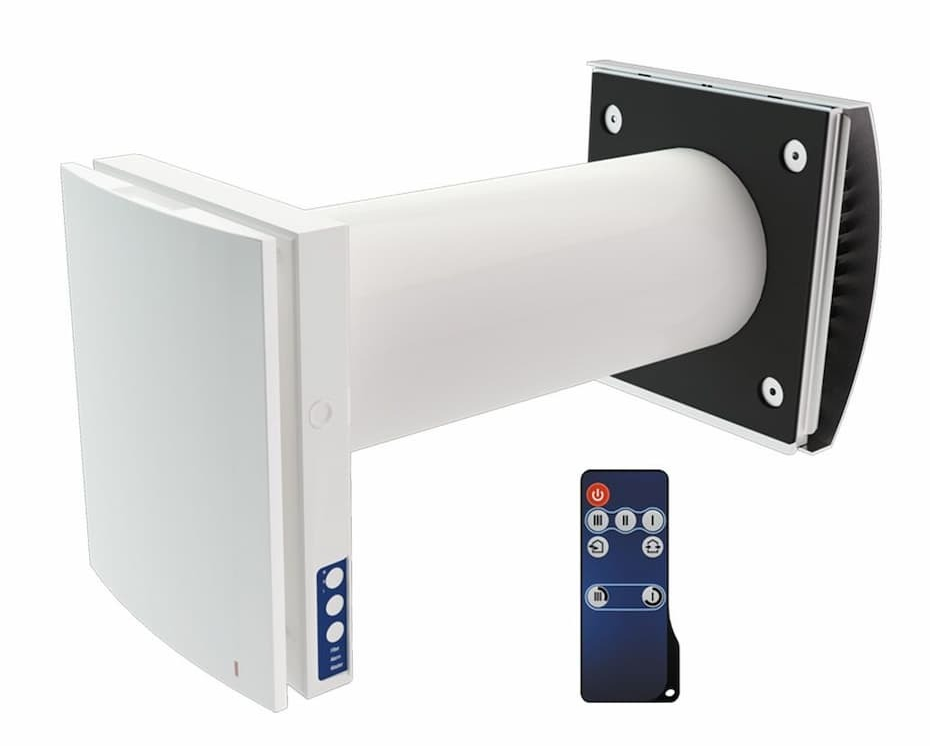
Single-room HRV units are wall-mounted and self-contained, making them particularly popular in bathrooms, kitchens, bedrooms, and home offices. Whole-house MVHR systems use a central unit with ductwork running throughout the property, though the underlying principle remains the same.
The Benefits in a Domestic Setting
1. Significant Energy Savings
The primary selling point of an HRV fan is its ability to retain heat that would ordinarily be expelled. A high-quality unit can recover between 70% and 95% of the thermal energy from outgoing air. In practice, this means that during cold months, incoming fresh air arrives at near room temperature rather than the ambient outdoor temperature.
For a well-insulated modern home, this can translate into a meaningful reduction in heating costs. Studies have suggested that effective heat recovery ventilation can cut ventilation-related heat losses by as much as 75%, representing a tangible saving on annual energy bills – particularly in colder climates like the UK, where heating demand is high for much of the year.
2. Improved Air Quality and Comfort
Poor indoor air quality is a growing concern. Modern homes, built or retrofitted to be increasingly airtight, can trap pollutants, carbon dioxide, allergens, and excess moisture. Without adequate ventilation, this leads to condensation, mould growth, and an uncomfortable – even unhealthy – living environment.
HRV fans provide continuous, controlled fresh air exchange without the draughts and temperature drops associated with opening windows or running traditional extractor fans. The result is a home that feels fresher and more comfortable, with reduced humidity levels and lower concentrations of indoor pollutants.
3. Moisture and Condensation Control
Bathrooms and kitchens are particularly susceptible to moisture build-up. Traditional extractor fans remove moisture effectively, but at a significant energy cost. An HRV unit installed in these rooms removes the humid air efficiently while recovering its thermal energy, keeping walls and windows drier without wasting the warmth that has already been generated by heating the home.
4. Quieter, More Efficient Operation
Modern HRV fans are engineered for low-noise operation, making them far less intrusive than traditional extractor fans. Many operate at sound levels below 25 decibels on their lowest setting – quieter than a whisper – which makes them suitable for continuous background ventilation, even in bedrooms.
5. Reduced Carbon Footprint
By reducing the amount of energy required to heat fresh incoming air, HRV fans contribute directly to a lower carbon footprint for the household. For homes aiming to improve their EPC (Energy Performance Certificate) rating, or those committed to reducing their environmental impact, fitting heat recovery ventilation is a practical and increasingly popular upgrade.
WiFi Connectivity and Smart Home Integration
The latest generation of HRV fans, such as those produced by Blauberg, goes a step further, embracing the connected home. Many leading manufacturers now offer models with built-in WiFi connectivity, allowing homeowners to monitor and control their ventilation remotely via a dedicated smartphone app.
Perhaps more excitingly, a growing number of models are now compatible with popular smart home platforms, including Amazon Alexa and Google Assistant. This opens up a range of practical possibilities:
- Voice control: Simply tell Alexa or Google Assistant to boost ventilation, switch to night mode, or turn the fan off – no need to reach for a switch or app.
- Automation and scheduling: Integrate the HRV fan with your existing smart home routines. For example, have the fan automatically increase airflow when your smart oven detects cooking activity, or reduce overnight ventilation speed as part of a bedtime routine.
- Remote monitoring: Check air quality readings and ventilation status from anywhere, ensuring your home is always comfortable even when you’re away.
- Integration with smart thermostats: Some systems can link with smart thermostats such as Nest or Hive, coordinating heating and ventilation for maximum efficiency.
These smart capabilities mean that an HRV fan is no longer just a passive ventilation device – it becomes an active participant in the intelligent management of your home’s energy use and comfort.
Installation Considerations
Single-room HRV units are generally straightforward to install. They require a core hole drilled through an external wall – typically around 160mm in diameter – to accommodate the ventilation sleeve. Professional installation is recommended to ensure correct placement, airtight fitting, and compliance with building regulations, particularly Part F of the UK Building Regulations, which governs ventilation standards.
Whole-house MVHR systems require more extensive installation involving ductwork and a central unit, typically located in a loft, utility room, or cupboard. These are best installed during new builds or major renovations, though retrofitting is also possible.
Is a Heat Recovery Fan Right for Your Home?
HRV fans are particularly well-suited to:
- Modern, well-insulated or airtight homes where natural ventilation is limited.
- Homes suffering from condensation, damp, or mould problems.
- Properties in colder regions where heat loss through ventilation is a significant cost.
- Homeowners looking to reduce their energy bills and environmental impact.
- Those investing in smart home technology and seeking cohesive, connected living.
For older, draughtier properties, the benefits may be less pronounced, as natural air infiltration already provides some level of ventilation. In these cases, improving insulation and draught-proofing first will make an HRV investment more worthwhile.
Conclusion
Heat recovery ventilation fans represent one of the most practical and cost-effective upgrades a homeowner can make. By recapturing the heat that traditional ventilation systems simply discard, they deliver fresher air, reduced energy bills, better moisture control, and a more comfortable living environment – all without compromise.
With the addition of WiFi connectivity and integration with smart home assistants like Alexa and Google Assistant, the latest models make managing your home’s air quality effortless and intuitive. Whether you’re retrofitting a single bathroom or specifying a whole-house system for a new build, heat recovery ventilation is fast becoming an essential feature of the energy-efficient, modern home.